Don’t Sweat the Bill When Your Air Conditioner Breaks Down
Understanding AC Repair Charges: Cost Breakdown by Component
When your cooling system stops working, the final invoice depends heavily on which component gave out. Central air conditioners are complex machines that blend high-voltage electrical circuits, delicate mechanical motors, and high-pressure chemical closed loops. A failure in one area can range from a quick, inexpensive part swap to a major overhaul.
The national mean for an HVAC service call hovers around $350, with standard repairs for components like contactors, fan motors, and thermostats typically landing between $150 and $650. However, when complex sealed-system parts fail, costs escalate rapidly.
| AC Repair Type | Average Cost Range (Installed) | Typical Repair Timeline | Complexity Level |
|---|---|---|---|
| Start / Run Capacitor | $150 – $450 | 30 – 60 minutes | Low (Electrical) |
| Contactor Replacement | $150 – $400 | 30 – 60 minutes | Low (Electrical) |
| Thermostat Replacement | $150 – $550 | 1 – 2 hours | Low to Moderate |
| Condensate Drain Unclogging | $100 – $250 | 45 – 90 minutes | Low (Plumbing/Safety) |
| Condenser Fan Motor | $300 – $700 (Standard) / up to $1,500+ (ECM) | 1 – 3 hours | Moderate (Mechanical) |
| Indoor Blower Motor | $450 – $1,200 | 2 – 4 hours | Moderate to High |
| Refrigerant Leak Repair & Recharge | $300 – $1,500+ | 2 – 5 hours | High (EPA Certified) |
| Evaporator Coil Replacement | $1,000 – $2,400 | 3 – 6 hours | High (Sealed System) |
| Compressor Replacement | $1,500 – $3,500 | 4 – 8 hours | Very High (Major Overhaul) |
When you need dependable, transparent solutions for these common component issues, turning to professional AC repair services ensures that every part is correctly sized, properly installed, and backed by a solid warranty.
Minor Electrical and Mechanical Fixes
Most service calls during warm weather involve minor electrical wear and tear. Constant cycling, summer heatwaves, and electrical surges place massive stress on smaller parts:
- Start and Run Capacitors ($150 – $450): Capacitors act like temporary storage batteries, delivering the initial electrical jolt required to kick-start your outdoor fan and compressor motor. Over time, high ambient temperatures degrade their internal chemistry. A swollen or dead capacitor is the single most common reason an AC hums but refuses to blow cold air.
- Contactors ($150 – $400): A contactor is an electromechanical switch that closes to send 240-volt power to your outdoor unit when the thermostat calls for cooling. Over years of operation, electrical arcing creates pitting and carbon buildup on the contact points, eventually causing them to stick open (no cooling) or weld shut (outdoor unit runs continuously).
- Thermostats ($150 – $550): Whether you need a standard digital unit or a smart, Wi-Fi-enabled system, faulty wiring, bad internal relays, or degraded sensors can cause irregular cycling or complete system lockouts.
- Condensate Drain Lines & Float Switches ($100 – $250): As your evaporator coil removes humidity from your indoor air, moisture collects in a drain pan and flows outside. Algae and sludge frequently clog these lines. If your system includes an overflow float switch, it will shut down the entire system to prevent water damage to your ceilings and floors. Clearing the line and installing a safety switch is a fast, affordable fix.
- Hard Start Kits ($150 – $350): For aging compressors struggling to overcome head pressure during startup, an aftermarket hard start kit provides an extra electrical assist, extending the operational life of the compressor.
Major Component Failures and Refrigerant Leaks
When mechanical motors burn out or the closed refrigeration circuit is compromised, the cost of labor and specialized equipment increases significantly:
- Indoor Blower Motors ($450 – $1,200): The blower motor inside your air handler or furnace forces conditioned air through your ductwork. Standard single-stage permanent split capacitor (PSC) motors fall on the lower end of the pricing spectrum, while modern electronically commutated motors (ECM) with variable speeds can push replacement costs toward $1,200 to $2,000.
- Condenser Fan Motors ($300 – $700+): Located in the outdoor unit, this motor spins the fan blades to expel heat pulled from your home. If it overheats or seizes, the compressor will quickly trip on thermal overload.
- Compressor Replacement ($1,500 – $3,500): Often referred to as the heart of your cooling system, the compressor pumps refrigerant between the indoor and outdoor coils. A mechanical seizure or internal electrical burnout represents the most expensive repair in residential HVAC.
- Refrigerant Leaks and Evaporator Coils ($300 – $2,400): Refrigerant does not get used up like gasoline in a car; your AC operates as a permanently sealed loop. If the charge is low, there is a physical hole in the copper tubing or aluminum coils. Pinpointing the leak with electronic detectors or nitrogen decay tests, brazing the copper, vacuuming the lines, and adding fresh refrigerant creates significant labor costs. If the indoor evaporator coil is severely corroded, replacing the entire coil assembly is generally the only permanent solution.
Key Factors That Drive Labor, Diagnostic, and Service Fees
When reviewing an invoice, labor and overhead often make up 50% to 70% of the total charges. Technicians across the United States generally bill between $75 and $200 per hour, depending on the local cost of living and regional business overhead.
Understanding how contractors structure their visits helps you avoid surprises when the bill arrives:
- Diagnostic Fees ($75 – $200): This covers the technician’s drive time, vehicle wear, fuel, and the professional expertise required to run diagnostic tests using specialized tools. Reputable companies clearly state this fee before dispatching a truck, and many will credit 100% of the diagnostic charge toward the repair if you approve the work on the spot.
- Flat-Rate vs. Time-and-Materials: Under a flat-rate model, you are quoted an upfront, all-inclusive price for a specific repair (such as $350 for a contactor replacement), regardless of whether the technician takes 30 minutes or two hours. Time-and-materials pricing charges you a strict hourly labor rate plus the wholesale markup on parts. Flat-rate billing provides pricing certainty, while hourly billing can sometimes save money on unusually quick jobs.
- Emergency Dispatch & Surcharges ($150 – $250+): If your air conditioning dies at 11:00 PM on a sweltering weekend, emergency repair requires mobilizing on-call technicians outside standard business hours.
Investing in comprehensive cooling services from an experienced team ensures you receive transparent diagnostics without hidden trip surcharges.
Factors That Influence AC Repair Charges
Several outside variables shift repair costs from one job to the next:
- Seasonality and Demand Spikes: HVAC companies experience extreme surges in call volume during the first prolonged heatwaves of summer. Scheduling non-emergency maintenance or minor repairs during the shoulder seasons—spring and autumn—can save you 10% to 25% on promotional service rates and ensure faster scheduling.
- Physical Accessibility: An outdoor condenser sitting cleanly on an open concrete pad is easy to service. An indoor air handler squeezed into a tight, 140°F attic crawl space or suspended above a high ceiling requires significantly more labor and safety precautions, raising the overall labor charge.
- OEM vs. Aftermarket Parts: Original Equipment Manufacturer (OEM) parts are built directly by your system’s original manufacturer and are mandatory to preserve active manufacturer warranties. High-quality generic aftermarket parts (often used for universal capacitors, contactors, or standard fan motors) can safely reduce component costs by $50 to $200 when a system is already out of warranty.
Refrigerant Economics: R-22 vs R-410A vs R-454B
Federal environmental regulations play a massive role in the cost of fixing refrigerant leaks. Technicians must hold EPA Section 608 Universal Certification to buy, handle, recover, and install refrigerants legally.
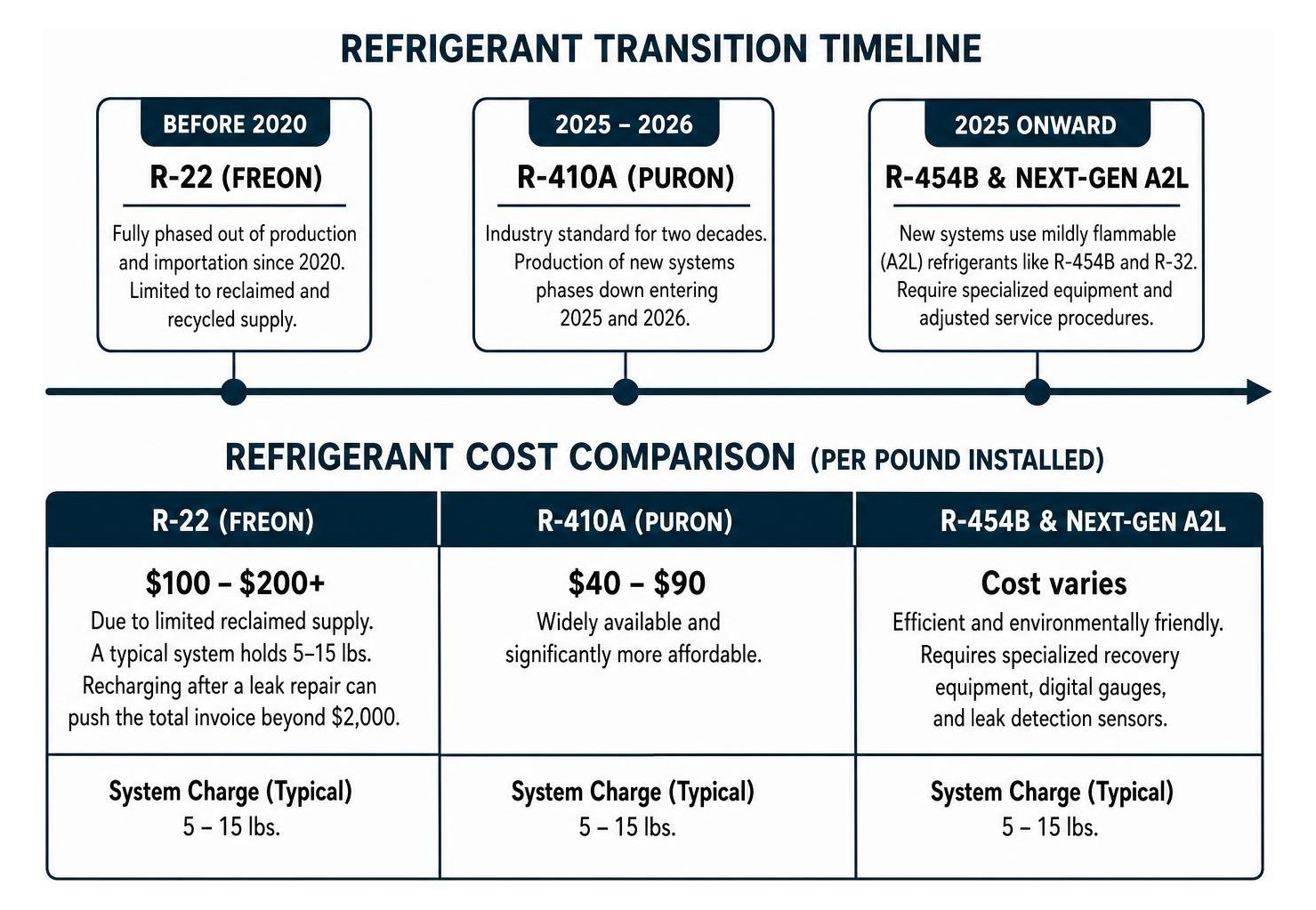
- R-22 (Freon): Fully phased out of production and importation since 2020 due to ozone depletion concerns, R-22 supplies are strictly limited to reclaimed and recycled stockpiles. Refilling an older R-22 system can cost anywhere from $100 to $200+ per pound. Because a typical residential central air system holds between 5 and 15 pounds of refrigerant, recharging an empty R-22 unit after fixing a leak can easily push the total invoice beyond $2,000.
- R-410A (Puron): The industry standard for the past two decades, R-410A is widely available and significantly more affordable, generally running $40 to $90 per pound installed. However, under the AIM Act, production of new R-410A systems phased down entering 2025 and 2026 to transition toward lower Global Warming Potential (GWP) alternatives.
- R-454B and Next-Gen A2L Refrigerants: Systems manufactured from 2025 onward utilize mildly flammable (A2L) refrigerants like R-454B and R-32. While environmentally friendly and highly efficient, servicing these systems requires specialized spark-proof recovery machines, digital manifold gauges, and leak detection sensors, which slightly shifts diagnostic procedures.
Repair vs. Replace: Making the Right Financial Decision
Facing a four-figure repair estimate forces every homeowner to answer the same question: Is it smarter to fix the current air conditioner or put that money toward a new system?
To avoid sinking good money into a dying unit, use the 50 Percent Rule: If the cost of the repair exceeds 50% of the cost of a comparable new system, replacement is the mathematically sound choice.
Central air conditioners and heat pumps have an average design lifespan of 12 to 15 years. As systems age past their tenth year, their electrical and mechanical components suffer cumulative thermal fatigue, and their operating efficiency drops considerably compared to modern SEER2-rated equipment.
A complete ducted central system installation typically ranges from $5,000 to $13,000+, depending on unit capacity, efficiency tiers, and duct modifications. If you are facing a $2,500 compressor repair on a 13-year-old R-22 system, paying for that repair rarely makes financial sense. Investing in a brand-new, energy-efficient AC installation backed by a 10-year parts and labor warranty eliminates surprise repair bills and lowers monthly utility bills. Homeowners can also take advantage of convenient financing options to spread the investment into predictable monthly payments.
How to Protect Your Budget and Avoid Getting Overcharged
The best way to ensure you are receiving fair pricing is to follow a systematic approach before authorizing any hands-on technical work:
- Demand an Itemized, Written Quote: Never accept a vague, verbal estimate over the phone. A professional estimate must clearly delineate the cost of parts, billed labor hours, refrigerant weight, diagnostic fees, and applicable warranties.
- Verify Credentials and Licensing: Ensure that any technician working on your equipment holds valid state licensing, active liability insurance, and EPA 608 Universal certification.
- Gather Two to Three Quotes for Major Repairs: If a contractor tells you that you have a dead compressor or a ruined evaporator coil with a price tag over $1,000, obtain a second opinion. A second diagnostic call ($75 to $150) is well worth the peace of mind to confirm that a simple capacitor failure was not misdiagnosed as a seized compressor.
- Leverage Service Plans: Enrolling in routine maintenance services is proven to cut annual repair bills by 30% to 50% over a 10-year window. Tune-ups clean dirt-caked coils, tighten vibrating electrical connections, and catch worn-out parts before they trigger expensive cascade failures.
How to Spot Inflated AC Repair Charges and Scams
While the vast majority of HVAC contractors are honest tradespeople, being aware of common overpricing tactics protects your household budget:
- The “Topping Off” Trick Without Leak Detection: If a technician adds several pounds of refrigerant to your unit without performing an electronic or pressure test to locate the leak, they are applying a temporary, expensive band-aid. Refrigerant cannot disappear without a physical breach; recharging without repairing means the new gas will simply leak out again.
- The “Condemned System” High-Pressure Pitch: Be wary of technicians who claim your system is an immediate health or fire hazard and pressure you to sign a replacement contract that same afternoon without providing detailed diagnostic test readouts (such as winding resistance ohms or capacitor microfarad ratings).
- The “Free Inspection” Trap: Be skeptical of ultra-cheap or completely free seasonal tune-up offers from unfamiliar companies. These are frequently used as sales funnels designed to get a salesperson into your home to find phantom problems and recommend complete system replacements.
- Uncredited Diagnostic Fees: Always confirm upfront whether the initial diagnostic fee is credited toward the final repair if you choose to proceed with their service.
Frequently Asked Questions About AC Repair Costs
Is it normal for an HVAC company to charge a diagnostic fee?
Yes. A diagnostic fee (typically between $75 and $200) compensates the contractor for the technician’s travel, specialized testing equipment, and professional expertise required to troubleshoot electrical, mechanical, and airflow issues accurately. Reputable HVAC companies will clearly disclose this fee before dispatching a vehicle and will often credit that amount toward the total cost if you approve the necessary repairs during the visit.
Why are refrigerant leak repairs so expensive?
Fixing a refrigerant leak requires far more than simply patching a pipe. A technician must legally recover any remaining refrigerant into an EPA-approved tank, pressurize the system with high-pressure dry nitrogen, use ultrasonic or electronic sniffer tools to locate the microscopic puncture, braze the copper joints with silver solder, pull a deep vacuum down to under 500 microns to boil out all moisture, and weigh in a virgin chemical charge to manufacturer factory specifications. This multi-step process demands hours of skilled labor and specialized tools.
How can routine maintenance reduce annual repair bills?
Industry data indicates that regular tune-ups ($150 to $250 annually) reduce ongoing repair expenses by 30% to 40%. During a maintenance visit, technicians clean the outdoor condenser and indoor evaporator coils, clear the condensate trap, measure motor amperages, inspect contactor points, and test capacitor microfarad ratings. Catching a $200 weakening capacitor early prevents it from overheating and destroying a $2,500 compressor down the line.
Conclusion
A broken air conditioner on a hot day is stressful, but understanding standard repair pricing, component lifespans, and refrigerant economics ensures you can make confident, budget-friendly decisions for your home. Always insist on written, itemized quotes, ask about diagnostic fee credits, and weigh the age of your system before agreeing to expensive repairs on older equipment.
Newman Air is a family-owned, locally-operated heating and cooling company serving homeowners and businesses throughout the Tri-Cities, TN area. We believe in total pricing transparency, friendly customer service, and honest advice you can rely on. Whether you need a quick electrical fix, an emergency service call, or an honest assessment of an aging unit, our certified technicians are ready to keep your home comfortable year-round.
Ready for honest, reliable cooling service? Contact Newman Air today to schedule your diagnostic visit or seasonal tune-up!